
Janesville, WI · Garage Door Service
What Cold-Climate Drafts Do to Janesville Garage Doors
Most Janesville garage doors date to the 1960s and 70s, with worn seals letting cold air and drafts into the house. Here's what fixing them actually costs.
- Repairs & new doors
- Springs & openers
- Serving 4 nearby communities
When Waiting Is Fine
Not every draft under the door means you need a new door. If the panel itself is straight and the springs are doing their job, a worn bottom seal or a cracked stop seal along the sides is usually a swap, not a replacement. Houses in this area were mostly built between 1942 and 1982, with the typical build year sitting around 1971, and a lot of those original steel panels are still structurally fine - it's the rubber and vinyl around them that gave out decades ago.
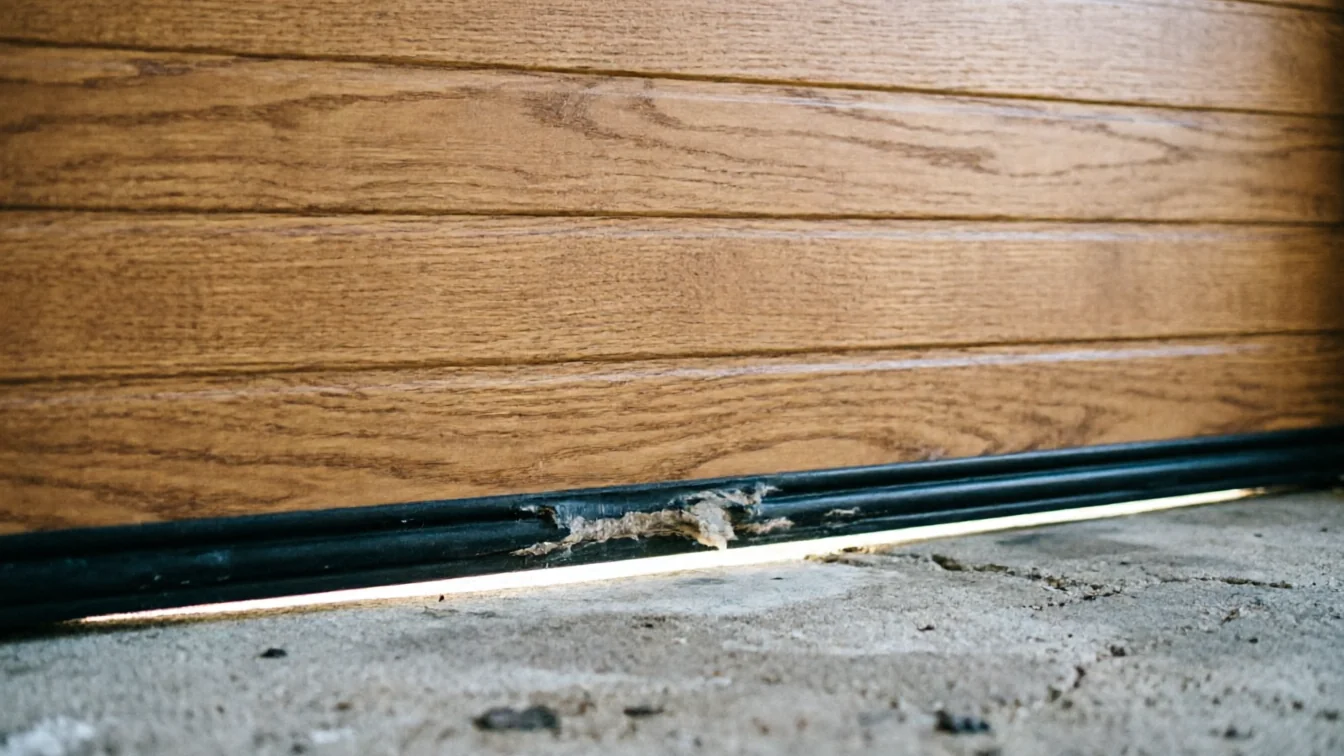
Here's the honest limit: if you've only got a thin gap of light showing at the bottom, or a bit of cold air coming through on the coldest nights, that can usually wait until it's convenient rather than an emergency call. We'd rather schedule it as a normal job than have you pay for a rush visit on a Saturday for something that isn't going to get worse overnight. Where it stops being fine to wait is when the seal has shrunk so much it's pulling away from the track, or when you can see daylight along the whole bottom edge - at that point you're just heating the driveway.
The Situation
The housing stock across this part of the service area runs mostly 1960s and 70s construction, spread across two dozen named neighborhoods, with 1971 as the rough middle point for build year. That generation of garage door came with whatever weatherstripping was standard at the time, which by today's standard is thin, and most of it has never been replaced. Thirty, forty, fifty winters of expansion and contraction will do that to a bulb seal.
The service area itself covers a wide stretch - from spots close in like La Prairie five miles out and Milton at seven, out past Edgerton, Clinton, and Lake Koshkonong in the low teens, to the outer edge near Whitewater and Delavan around sixteen to twenty miles. That's a lot of ground with the same basic housing-age pattern repeating: original doors, original hardware, original seals that are long past their working life. With 37,688 households and 18,518 owner-occupied houses in the area, the number of doors still running on 1970s-era weatherstripping is not small.
What Local Conditions Do
This area sits in a severe cold climate band, which matters more for a garage door than people expect. It's not just that it gets cold - it's the freeze-thaw cycling. A vinyl seal that's fine at a steady 20 degrees will crack where it bends once it's gone through forty or fifty freeze-and-thaw swings over a winter. Steel tracks and door panels contract in the cold too, which opens small gaps at the corners that weren't there in July.
On a door built to 1960s or 70s standards, there often wasn't much insulation in the panel to begin with, so a failing seal isn't just a draft - it's cold air moving straight through a door that was never built to stop it either way. You'll usually notice it first as a cold floor near the garage-adjacent wall, or a thin line of frost forming along the bottom seal on the coldest mornings. That frost line is a good sign the seal has already lost its seal against the slab, not just gotten stiff.
What It Costs
We don't have a flat number to quote here, because what you're dealing with changes the job completely. Swapping a bottom seal or side stop weatherstripping on a door that's otherwise sound is a different job from replacing the whole panel assembly on a door old enough that parts aren't stocked for it anymore. Door width, the seal style your track uses, and whether the track itself has shifted all move the number.
What we can say is that most owners in this area, where median household income runs around $78,008, choose the repair-the-seal route first when the door and opener are otherwise working - it's the cheaper fix and it solves the actual problem in most cases. A full door replacement only makes sense once the panel itself is bowed, rusted through, or the insulation inside has broken down, and that's a separate conversation from a drafty seal. Ask us to look at it before assuming you need the bigger job.
Frequently asked questions
How do I know if it's just the seal or the whole door?
Look at the bottom edge with the door closed on a sunny day - if you see a thin, even line of daylight, it's probably the seal. If the gap is uneven, wider on one side, or the panel looks bowed, that's more likely a track or panel issue that a new seal won't fix on its own.
Why does my garage feel colder than it used to?
If your house was built in the 1960s or 70s like most around here, the original weatherstripping has had decades of freeze-thaw cycling working against it. Vinyl and rubber get brittle and shrink with age, and once that seal pulls away from the slab, cold air gets a straight path in.
Does the seal wear out faster here than somewhere warmer?
Yes - this area sits in a severe cold climate band, and repeated freezing and thawing is harder on seal material than steady cold would be. Each cycle flexes the vinyl a bit more until it cracks, which is why seals here often need replacing sooner than the rest of the door.
Is replacing the seal something I can put off until spring?
If the draft is minor, yes - it's not an emergency. But if you can already see daylight or frost forming along the bottom edge, waiting through the rest of winter means paying to heat the garage and the room next to it the whole time.
Related garage door services in Janesville
More garage door guides
Book garage door service in Janesville
Call now or request a quote - tell us what the door is doing and where you are.