Janesville, WI · Garage Door Service
Is Your Old Janesville Garage Door Worth Fixing?
Janesville homes mostly date 1942-1982. Here's how to tell if your original door and hardware are worth repairing or if cold-climate wear means replacement.
- Repairs & new doors
- Springs & openers
- Serving 4 nearby communities
When Waiting Is Fine
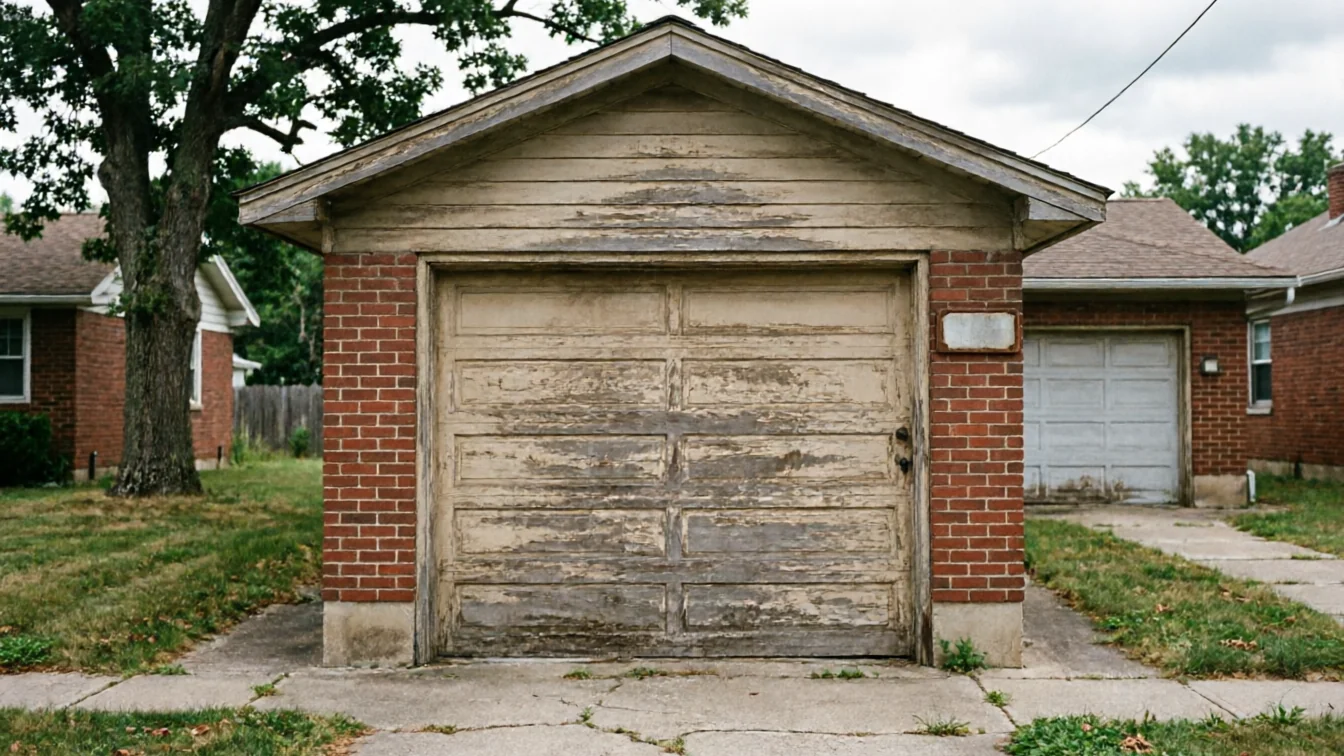
If your door still opens square, the spring isn't making that flat clunk, and the panels aren't buckled, you don't need to call anyone yet. A lot of the doors we look at in Janesville are original to houses built between 1942 and 1982, and plenty of that hardware is still doing its job. Rollers that are a little noisy but not seized, a track with minor surface rust, a weatherstrip that's cracked but not torn through - none of that is an emergency. Waiting makes sense when the door still moves evenly on both sides and the opener isn't straining. What doesn't make sense is waiting once a cable starts to fray or a panel seam starts to separate, because cold makes both of those fail faster, not slower. The honest answer for most of these older doors is: keep using it, keep an eye on it, and call when something changes instead of on a schedule.
The Situation
Janesville's housing stock skews old - median build year 1971, with most of it going up across the 1960s and 70s in the 24 or so named areas that make up this market. That means a lot of single-car and narrow double doors on hardware that predates the lighter steel and nylon rollers you'd get today. Original torsion springs from that era were sized for heavier wood-core panels, and when a homeowner swaps in a lighter insulated door without resizing the spring, the opener works harder than it should. We also see doors where the track was never upgraded when the opener was replaced - a mismatch that shows up as grinding or binding, especially in winter. None of this is unusual for a town this age. It's just the pattern you get when most of the garages were built for a different door than what's hanging in them now.
What Local Conditions Do
This is a severe cold climate, and that changes what breaks and when. Steel contracts in deep cold, so clearances that were fine in July get tight in January - a track that's a sixteenth of an inch off alignment in summer can bind hard once temperatures drop. Torsion springs lose a measurable amount of lifting power in cold weather too, which is why a door that opened fine in fall suddenly feels heavy by December. Nylon rollers handle this better than steel ones, but a lot of the original hardware on these 1960s and 70s doors is steel-on-steel, with no cold-weather give built in. Weatherstripping is the other piece: on an older door it's usually hardened and shrunk, which lets drafts and road salt spray into the garage. None of that means the door is done - it means the parts most worth checking before spring are the ones cold stresses hardest: spring tension, roller type, and track alignment.
What It Costs
We don't have a flat number to give you here, because what an older door is worth fixing depends on what's actually failing. A spring swap or roller replacement on a structurally sound 1960s or 70s door is usually worth doing - the panel and frame are often heavier-gauge steel or solid wood than what's sold new today. What's not worth fixing is a door with a cracked or delaminated panel, since those were built before foam-core insulation was standard and a cracked panel on an uninsulated door won't hold up through another severe winter. The honest limitation: we can't quote a repair over the phone sight-unseen, because two doors from the same era can be in very different shape depending on how they were maintained. What we can tell you is that in this climate, hardware condition matters more than the door's age by itself.
Frequently asked questions
My garage door is original to a house built in the 1960s. Is it too old to repair?
Not necessarily. Age alone isn't the issue - a lot of 1960s and 70s doors in Janesville are heavier-gauge steel or solid wood and structurally sound. What matters is whether the panel is cracked or delaminated and whether the spring and rollers have been maintained. We look at condition, not just the build year, before telling you repair or replace.
Why does my door feel heavier in winter?
Torsion springs lose lifting power in severe cold, and steel hardware contracts slightly, tightening clearances that were fine in warmer months. That combination is common on older doors in this climate and is usually a spring tension or roller issue rather than a sign the door itself is failing.
Is it worth upgrading the weatherstripping on an old door instead of replacing the whole door?
Often, yes. Hardened or shrunk weatherstripping is one of the most common issues on original doors from the 1960s and 70s, and it's a low-cost fix compared to full replacement. It won't fix a cracked panel or failing spring, but it addresses the draft and salt-spray problem on its own.
Related garage door services in Janesville
More garage door guides
Book garage door service in Janesville
Call now or request a quote - tell us what the door is doing and where you are.