
Janesville, WI · Garage Door Service
What Actually Happens When We Come Out to Your Door
See exactly what a Janesville Garage Door Pros service call checks on 1942-1982 housing stock, cold-climate wear points, and what drives the final bill.
- Repairs & new doors
- Springs & openers
- Serving 4 nearby communities
When Waiting Is Fine
Not every noise is an emergency. If your door is slow to close, the opener light blinks but the door still moves, or a roller squeaks on the way up, you can usually wait for a scheduled visit instead of paying for a rush call. Most of the houses we get called to here went up between 1942 and 1982, with the thickest cluster from the 1960s and 70s spread across the 24 named areas we cover. That means a lot of original hardware is aging out at roughly the same pace, and minor wear - a dry hinge, a loose bracket, a track that's a little out of square - is common and not urgent on its own.
What changes the math is a broken spring, a cable off the drum, or a door that won't move at all. Those don't wait, because a door stuck open is a door you can't secure, and a stuck torsion spring under tension is a hazard, not a maintenance item. If you're unsure which category you're in, describe what you're seeing when you call - what it's doing, when it started, whether it happened all at once or gradually. That one detail usually tells us more than the make of the door does.
The Situation
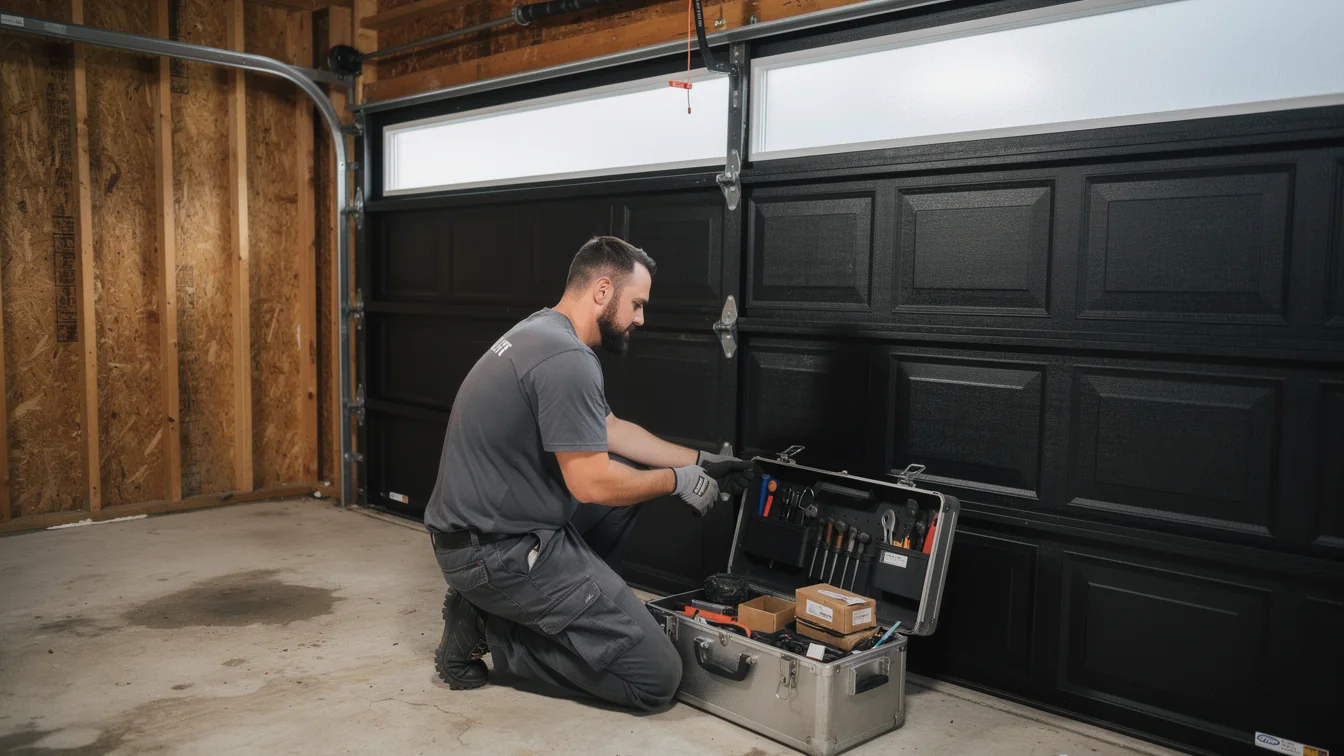
On a first visit, we're not just looking at the one part that's loud or stuck. We check the spring size and wind against the door weight, the condition of the cables and drums, how the track lines up on both sides, and whether the opener's force and limit settings still match the door. On houses from this area's 1960s-70s building wave, we're often looking at side-mount torsion hardware or an early extension-spring setup that was sized for a lighter door than what's hanging on it now, especially if a steel replacement panel went in at some point without re-checking the spring.
We also look at what's not broken yet. A cable fraying at the drum, a bottom bracket with hairline rust, an opener gear set worn thin - these show up during inspection long before they fail on their own. Given how much of the stock here falls in the same narrow build window, we see the same failure patterns repeat house to house: original hardware that's simply reached the end of its service life around the same time its neighbors' did. The call covers telling you which of those you're looking at and what order to deal with them in.
What Local Conditions Do
Janesville sits in a cold-climate band severe enough to matter for a garage door. Steel panels contract in deep cold and expand back in a thaw, which over enough winters works screws loose and opens gaps at the seams. Lubricant that was fine in October gets stiff by January, which is part of why a door that closed smoothly all fall can start grinding or hesitating once temperatures drop. Openers with photo-eye sensors can also act up in cold garages if condensation forms on the lenses, which reads to the opener as an obstruction even when the path is clear.
A lot of the garages attached to this era of housing - built 1942 to 1982 - were not built with much insulation in mind, so the swing between a heated house and an unheated garage is often sharper here than in newer construction. That swing is hard on weatherstripping and on the metal fatigue that eventually shows up as a cracked panel or a popped hinge. Part of a service call in this climate is checking for cold-weather symptoms specifically, not just whatever the door is doing the day we show up.
What It Costs
We're not going to hand you a flat number here, because the honest answer is that it depends on what we find - spring size and wind, whether the opener needs a part or a full swap, whether the track needs realigning or replacing. A door on a house from the 1960s-70s stock common in this service area often needs different parts than a door on a house built in the last fifteen years, and that affects both the part cost and how long it takes to source.
What we can tell you is what the call itself includes: diagnosis of the actual failure, not just the symptom, and a clear breakdown before any repair starts, so you're deciding on real numbers instead of a guess. One limitation worth saying plainly - if your door and opener are old enough and worn enough across enough parts at once, repair can cost close to what replacement would, and we'll tell you that instead of running up a repair bill that doesn't make sense. That's a judgment call we make case by case, not a standard answer.
Frequently asked questions
Do you charge extra for an emergency call versus a scheduled one in Janesville?
Timing affects cost - a same-day call for a door stuck open or a snapped spring is priced differently than a scheduled visit for a slow-closing door or a noisy roller. We don't have a published flat rate for either; it depends on what's actually wrong once we're there.
Why does my opener act up more in the winter?
Cold stiffens lubricant and can cause condensation on photo-eye sensors, both of which show up as a door that hesitates, reverses, or won't close. It's common in this climate band, especially in garages attached to older, less-insulated houses typical of this area's 1960s-70s housing.
Is it worth repairing an old torsion spring setup or should I replace the whole system?
If the spring is the only thing failing and the rest of the hardware is sound, a spring swap usually makes sense. If the opener, track, and cables are all original and showing wear at the same time, which is common on houses from the 1942-1982 build era, replacement can end up cheaper than repair piece by piece.
What should I check before calling, to save time on the visit?
Note exactly what the door is doing - won't move, moves partway, grinds, reverses - and whether it's sudden or gradual. If you know roughly when your house was built, that helps too, since hardware age tracks pretty closely with the housing stock across this area.
Related garage door services in Janesville
More garage door guides
Book garage door service in Janesville
Call now or request a quote - tell us what the door is doing and where you are.